Montagne
In 2009, I started a photography project focusing on the iconic Swiss-Italian mountain, the Matterhorn/Cervino. To commemorate the 150th anniversary of its first, tragic ascent in 1865 by Edward Whymper and his party, the idea was to photograph the mountain from multiple vantage points over the full 360° arc. I used a 4x5 inch view camera, similar to the equipment employed by the pioneers of alpine photography at that time. However, the project never reached completion.Philippe Vandenbroeck
Recently, I came across a text by the French phenomenologist Henri Maldiney (1912–2013) titled Montagne, which uses the Matterhorn/Cervino as a focal point for reflection on its originary presence.
Quand la montagne apparaît, cette vapeur flottante, cette montée d'ombres, cette fuite de neige, moments disparaissants, s'appellent de tout l'espace impliqué dans son rythme. Cette vapeur n'appelle pas seulement l'amplitude du ciel, ni l'abrupt de cette pente de soulèvement de la terre, mais chacun participe de l'indivisible rythmique de la montagne. Toutes les dimensions (hauteur, largeur, profondeur) se conjuguent dans une unitridimensionalité dynamique, dont les lignes de force opposées (verticales et horizontales, creux et reliefs, "embrassement immense et recel latent" constituent le rythme. Ce qui dans l'instant s'ouvre à nous en s'ouvrant à soi c'est cette unité.
When the mountain appears, that floating mist, that rising tide of shadows, that drifting snow—fleeting moments—call out to the whole of space, drawn into its rhythm. This mist does not merely evoke the vastness of the sky, nor the steepness of this slope where the earth rises, but each element participates in the mountain’s indivisible rhythm. All dimensions (height, width, depth) converge in a dynamic unity of three dimensions, whose opposing lines of force—vertical and horizontal, hollows and ridges, ‘immense embrace and latent concealment’—constitute its rhythm. What opens up to us in that instant, whilst opening up to itself, is this unity.
Hendri Maldiney, Ouvrir le rien. L'art nu. Encre marine, 2000, p. 42-43
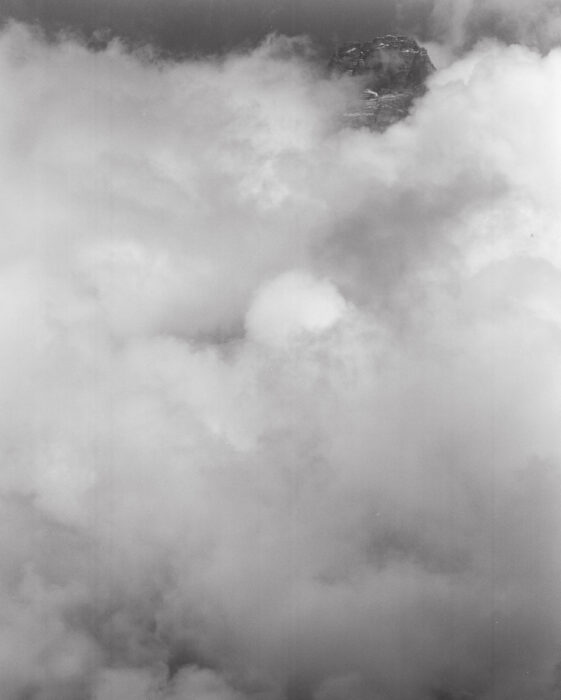
The project was: to photograph the Matterhorn from all directions. But ‘from all directions’ already implies that a sum of viewpoints brings one closer to ‘the’ mountain, that completeness, however asymptotic, is the right goal. That is precisely what Maldiney’s text denies: the space of the mountain is an ‘ensemble impossible’, a collection that cannot contain itself as an element. Seen as such one could never be ‘done’ with this project in the sense in which it was originally conceived because its very form (as a survey) contains an assumption that Maldiney's Daoist-inspired phenomenology rejects.